

District Commitment: Every school in Granite School District will offer a learning environment where safety, responsibility, and respect prevail and where every student receives support for achieving academic goals and personal aspirations.
Section 1: School-Wide Behavior Plan (Tier I)
- What are your school-wide PBIS behavior expectations? (3-5 positively-stated, specific behavior expectations for your school that build on the district commitment as stated above)
THE PANTHER WAY – Living the Kearns Values
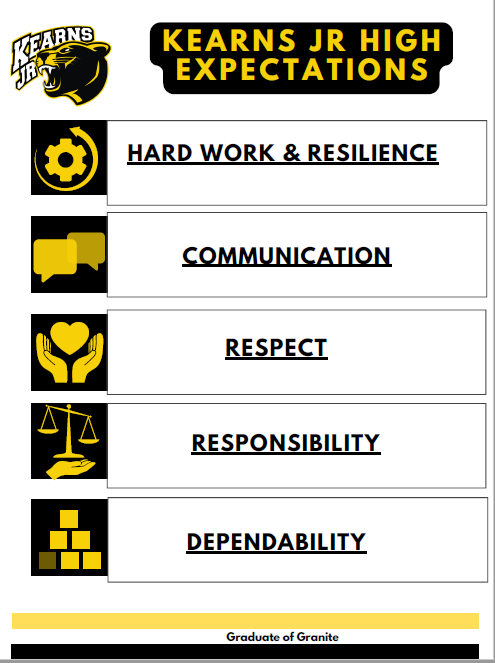
Kearns Jr. High Expectations image details
KEARNS JR HIGH EXPECTATIONS
- Hard Work & Resilience
- Communication
- Respect
- Responsibility
- Dependability
Graduate of Granite
2. When do you teach your behavior expectations and flowchart to all students and staff?
- Staff Teaching/Re-teaching Schedule: Week 1 of First Semester
- Student Teaching/Re-teaching Schedule: Week 1 of Second Semester
- Teacher-directed reteaching of expectations as needed.
3. What is your Tier 1 PBIS reinforcement system?
- Panther Paws: Students receive points for meeting/exceeding behavior expectations
- School Store: Students can redeem points for various prizes
- Panther Club for weekly & quarterly incentives
- Student of the week recognitions: Students are nominated by their teachers to meet with admin for recognition. This is followed by a phone call home to share positive message with parents and guardians.
4. What is your school-wide system to address behavior infractions?

Kearns Jr. High Discipline Flow Chart image details
Kearns Jr. High Discipline Flow Chart
We are calm, collected, and neutral when we are correcting behavior.
Step 1: Verbal Redirection
- Restate school-wide/class expectations
- Clarify how behavior did not meet them
Intervention Successful? Yes: Reinforce Expectations. No: Proceed to Step 2.
Step 2: Reset/Restore
- Student reflects via guided questionnaire
- Uses a calming tool
- Has opportunity to make amends
- Timer set for rejoining class
Intervention Successful? Yes: Reinforce Expectations. No: Proceed to Step 3.
Step 3: Student/Teacher Conference
- Private conversation to explore root causes
- Restorative practices
- Optional documentation in Focus as a MINOR INCIDENT
Intervention Successful? Yes: Reinforce Expectations. No: Proceed to Step 4.
Step 4: Reflection & Phone Call Home
- Student fills out form in nearby classroom
- Review form with student
- Inform parent
- REQUIRED documentation in Focus as a minor incident
Intervention Successful? Yes: Reinforce Expectations. No: Proceed to Step 5.
Step 5: Referral to Administration
- Document in Focus as an Office Referral
- Bring concerns to grade level team if behaviors are chronic
Minor Incidents: Cheating, Class disruption, Computer violation, Dress code, Insubordination, Inappropriate language, PDA, Refusal to work, Sleeping, Tone/attitude, Tardiness.
Immediate Office Referrals: Assault, Bullying, Drugs/alcohol/tobacco, Gang activity, Fighting, Sexual harassment, Theft, Threats/intimidation, Truancy, Other illegal activities.
Immediate Office Referral — Document in Focus.
Examples of Reinforcing Expectations: Praise (4:1 ratio), Panther Paw, positive phone call/postcard, Nominate as student of the week, Teacher Choice.
Vision: Empowering students. Visualizing possibilities. Creating opportunities.
Section 2: School-wide Bully Prevention Plan
- How do your school-wide expectations/rules relate to teaching bullying prevention? (e.g., Respect, Kindness, Thoughtful)
The Panther Way: This incorporates the Graduate of Granite dispositions with a focus on being responsible, compassionate, and respectful to their fellow students.
2. How do you incorporate bully prevention in teaching your school-wide expectations to students and staff?
| School-wide involvement: | Staff members have a duty to maintain active supervision, intervene, and report any instances of bullying they witness or that are reported to them. Safe UT App roll out: Students are trained and encouraged report any instances of bullying via the SafeUT App or directly to admin for proper investigation. SEL Curriculum: Addressing Bullying Specifically |
|---|---|
| Student involvement: | Buddy Box: An anonymous way to report incidents |
| Community involvement: | Patron Concern form Safe UT App Direct report to the front office by phone or email, or in person |
Granite School District teaching videos: Is this bullying? A quick guide and What happens when bullying is reported
Bullying is Never OK! (YouTube video)
3. Which curriculum do you use to explicitly teach bully prevention to all students and staff? When is this taught (timeline)?
| Curriculum | Timeline |
|---|---|
| SEL curriculum delivered by advisory | Monthly advisory lessons |
4. What are the procedures for addressing the following behaviors? Include the standard interventions and consequences in your school for each behavior.
| Behavior | Procedures | Documentation | Interventions | Rewards/Consequences |
|---|---|---|---|---|
| Bullying | Investigation Administration meeting Parent Contact | Educator Handbook Witness Statements Discovery | Ongoing Monitoring Limiting interactions with victim | Suspension Referral to Safe School |
| Bullying with an aggravating component i.e. derogatory remarks based on sex, sexual preference, or race | Investigation Administration meeting Parent Contact | Educator Handbook Witness Statements Discovery | Ongoing Monitoring Limiting interactions w-victim Anti-bullying Contract | Suspension/In-School Suspension Referral to Safe School Referral to Law Enforcement |
| Cyber-bullying | Investigation Administration meeting Parent Contact | Educator Handbook Witness Statements Discovery | Ongoing Monitoring Limiting interactions w-victim Anti-bullying Contract | Suspension/In-School Suspension Referral to Safe School Referral to Law Enforcement |
| Hazing/ Harassment | Investigation Administration meeting Parent Contact | Educator Handbook Witness Statements Discovery | Ongoing Monitoring Limiting interactions w-victim | School Suspension Referral to Safe School Referral to Law Enforcement |
| Mutual Altercation | Investigation Administration meeting Parent Contact | Educator Handbook Witness Statements Discovery | Ongoing Monitoring Limiting interactions w-victim | Suspension Referral to Safe School |
| Verbal aggression using “fighting words” | Investigation Administration meeting Parent Contact | Educator Handbook Witness Statements Discovery | Ongoing Monitoring Limiting interactions w-victim anti-bullying contract Restorative Justice & Reconciliation | Suspension In School Suspension |
| Retaliation | Investigation Administration meeting Parent Contact | Educator Handbook Witness Statements Discovery | Ongoing Monitoring Limiting interactions w-victim |
5. What are the procedures for providing support to targeted students?
| Role | Procedures (i.e. student support form) | Interventions/ongoing support |
|---|---|---|
| Victims | Witness Statements Parent Contract Copy of Behavior Contract Teacher Notification Seat/Class change | Access to Administration Counseling Services Check-ins with teachers |
| Perpetrator | Witness Statements Parent Contract Copy of Behavior Contract Teacher Notification Seat/Class change | Structured Lunch Behavioral Contract Referral to the SST Team Check-in/check-out Daily Behavior Tracker |
6. Describe your school’s reporting system if administrators, teachers, or staff encounter bullying.
Focus Discipline: All minor and major behavioral incidents are documented in Focus Discipline to help us identify patterns, monitor trends, and implement appropriate interventions to address problem behaviors.
7. How do students, parents, or other patrons report bullying or other anti-social behaviors? How are these reporting channels communicated clearly to parents?
Students, parents, and other patrons may report bullying or other antisocial behaviors by submitting a Patron Concern Form, using the SafeUT App, or reporting concerns directly to a school administrator or other trusted staff member. These reporting options are communicated to families through school communications, including newsletters, the school website, and other schoolwide outreach.
8. How does your school respond to reports of bullying or other anti-social behaviors?
When reports of bullying or other antisocial behaviors are received, administrators follow an established investigation protocol. This includes interviewing the individuals involved and relevant witnesses, reviewing available evidence, and notifying parents or guardians. Based on the findings, the school may implement a safety plan or other appropriate interventions. Counseling and additional support may also be provided to both the affected student and the student engaging in the behavior to promote safety, accountability, and positive behavioral change.
9. Do you report behavior issues that are significant or persistent in Focus (state codes only)?
- Focus for state codes – YES
- Are teachers using Educators’ Handbook? – NO. We use Focus Discipline in lieu of Educators Handbook
Section 3: School-Wide Suicide Prevention Plan
- How is suicide prevention taught in your school?
- SEL lessons via advisory
- One-on-one visits with the social worker/counselors
- Small Groups Social skills training
- What evidence-based suicide prevention practices and programs are you implementing in response to State Board Rule R277-620?
- Our school implements several suicide prevention practices and supports, including promoting access to the SafeUT App, providing age-appropriate suicide prevention and mental health lessons facilitated by school counselors and the social worker, and offering individual counseling and intervention services for students in need. We also collaborate with families and community resources to ensure students receive appropriate support and referrals when necessary.
- What is your procedure for addressing suicidal ideation?
- Pink Sheet
- Informing parents
- Referred to SST
- Referred to Counselors/School Social Workers
- Referral to outside resources
- Describe your school’s reporting system if administrators, teachers, or staff encounter threats of suicide.
- Referral to Counselors/Admin
- Parent notification/meeting
- Referral to SST/outside resources
- How do students, parents, or other patrons report threats of suicide? How are these reporting channels communicated clearly to parents?
- SAFE UT App
- Direct School Communication
- How does your school respond to reports of suicide threats?
- Risk Assessment conducted by our school Counseling Team
- Counseling support
- Parent notification
- Sharing outside resources
Section 4: Substance Abuse Prevention
Granite School District is committed to the prevention of drug, alcohol, tobacco, and E-cigarettes/vaping use by our students and is aware of the connection and effect these have on physical and mental health and on learning. A key component is INCREASING protective factors and REDUCING risk factors in a student’s life. As with other behavior expectations, our school teaches, reinforces, and corrects substance abuse prevention and follows the district substance abuse policy.
| Substance abuse prevention learning | Consequences of violation | Substance abuse prevention resources |
|---|---|---|
| -Mindfulness training -SafeUT training -Refusal skills lessons in advisory -7th grade health lessons | Possession/Use: 1st Offense | Suspension, Quit course 2nd Offense | Alternative placement 3rd Offense | Prolonged alternative placement | For Parents: Marijuana Talk Kit (PDF) Parents Empowered Partnership for Drug-Free Kids For Students: NIDA for Teens Above the Influence Just Think Twice For Educators: Foundation for a Drug-Free World Prevention Dimensions Curriculum NIDA Educator Resources |
| Selling/Distributing: Alternative placement for 90 school days |
Section 5: Interventions, Reporting, and Discipline (Tier 2 & 3)
- Do you report all incidents of bullying, cyber-bullying, hazing, harassment, or threats of suicide to parents? YES
- Are you protecting that information? Yes
- What documentation is kept to ensure communication has occurred? We maintain documentation of communication and interventions through Focus, anti-bullying and no-contact contracts, daily meeting logs, and other relevant student records. This documentation helps ensure that communication, supports, and follow-up actions are consistently recorded and monitored.
2. What data do you use to determine re-teaching priorities for Tier 1? Focus discipline data, Panorama, classroom observations, and Attendance
3. How frequently do you share office referral trend data with the entire staff? Quarterly
4. What behavior data are you using to identify students/groups of students in need of Tier 2 interventions? Attendance, Focus, teacher input, classroom observations, Work Completion, and Panorama Student surveys
5. What behavior data are you using to identify students/groups of students of Tier 3 Interventions? We use multiple sources of behavior data to identify individual students and groups who may require Tier 3 interventions. These sources include SafeSchool reports, classroom observations, suspension data, SST forms, parent/guardian input, Focus data, and Panorama student surveys. Together, these data points help us identify patterns, determine student needs, and provide intensive, individualized supports.
Student Support Team (SST)
- Who are the members of your SST? Representation must include: an administrator, core teacher(s), counselor(s), psychologist(s), social worker(s), other gen-ed specialists, & an SRO (secondary).
| Name | Title |
|---|---|
| Kelli Miller/ Elvis Fonguh / Kason Kendall | Admin |
| Corianne Reynolds / Traci Sutherland /Dylan Ball | Counselors |
| Amber Woodward | Social Worker |
| Mary Dennis | School Psychologist |
| Chelsea Lind | School Nurse |
| Gloria Aceves | SPED Department |
| Emma Sturdevant/Liz Green | Instructional coaches |
2. How does your SST utilize school-wide data to identify trends and groups of students who need support? Our SST utilizes schoolwide data from multiple sources, including Focus, attendance data, the Early Warning System, risk indicators, and Panorama student surveys, to identify trends and groups of students who may need additional support. This data helps us proactively identify student needs and develop targeted interventions and supports.
3. How does your SST utilize the Student Support Process (flowchart and forms) to identify students and groups of students who need extra support or interventions? Our SST utilizes the Student Support Process, including the flowchart and supporting forms, to systematically identify students and groups who need additional support or interventions. The process allows us to gather input and involve key stakeholders—including parents, teachers, counselors, the school nurse, school psychologist, and other relevant staff—to develop a comprehensive understanding of each student’s needs. This collaborative approach helps ensure that appropriate, targeted interventions are identified, implemented, and monitored.
4. What methods of communicating concerns or specific behavior plans, supports, and interventions for particular students are shared with others who are in a position to assist the student, including the parents/guardians? Methods of communication include professional learning sessions, in-person meetings, emails, and phone calls.
5. What specific school-wide Tier 2 behavior interventions do you have in place? Our school provides several Tier 2 behavior interventions, including Check-In/Check-Out, social skills groups, school-based mentoring, reteaching groups, self-management strategies, and individualized behavior contracts. These interventions provide targeted support to help students improve behavior and develop essential social-emotional skills.
6. What specific school-wide Tier 3 interventions do you have in place? Our school provides several Tier 3 interventions for students requiring intensive, individualized support. These include Individual Behavior Intervention Plans (BIPs), 504 Plans, Individualized Education Programs (IEPs), school-based counseling provided by the school social worker or psychologist, community wraparound services, and assigned paraprofessional support, such as Behavioral Health Associates (BHAs) or Behavioral Support Technicians (BSTs).
7. How did/will you train/discuss the student support process and the role of the Student Support Teams?
| How | Date |
|---|---|
| Students: Focus Discipline/Class Meetings | 8/5/26 |
| Staff: Student Handbook Review/Faculty Meeting/Grade Level Teams | 8/05/26 |
| Patrons: Student Handbook-Registration | 7/31/26 |
Section 6: COMMUNICATION
School Behavior Plans must be linked on school website including hierarchy of infractions, rewards and consequences.
- Is the plan posted on the school website? YES
- How else is this information communicated to patrons?
- Parent/Student/Counselor/Administrative Meeting
- Weekly Newsletter
- Community Council
- Is information communicated in multiple languages? YES
- How is this behavior plan communicated to staff? Professional Development, Faculty handbook, & Faculty Meetings.
Who is your school contact for feedback on your Behavior Plan?
| Name | Phone | |
|---|---|---|
| Elvis Fonguh | Email Elvis Fonguh | 385-646-3502 |











You must be logged in to post a comment.