
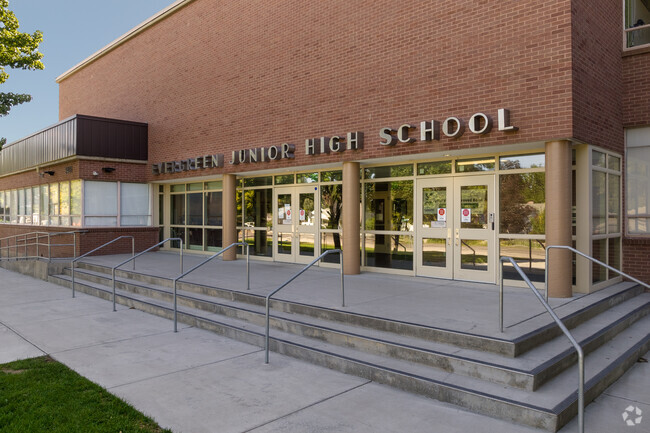
Thank you for visiting the Evergreen Junior High Community Council webpage. We invite you to be a part of it, serve on it, and come to our meetings. School Community Councils are one way we can work together to make Evergreen more successful and promote school improvement. The Community Council members work to improve the school environment and provide feedback on school programs. School Community Council members serve for a term of two years and must have a child attending our school. The time commitment is around an hour a month. The Evergreen Junior High Community Council follows these Rules of Order. All are welcome to come to our meetings!
Meeting Schedule and Agenda
Community members are invited to attend council meetings, but are not voting members. If you have a concern for your Community Council, please reach out to one of the council members.
- Location: Evergreen Jr Hub
- Time: 9:45 AM
- Next Agenda: Review the agenda for our upcoming meeting.
- Schedule: Every 1st student attending Monday from August-May.
- Meeting Dates:
- No meeting in August.
- 09/14/26
- 10/05/26
- 11/02/26
- 12/07/26
- 01/11/27
- 02/01/27
- 03/01/27
- 04/12/27
- 05/03/27
Council Members
Council Members are chosen by election and are a mixture of school staff and community members. Candidacy and election procedures begin before each school year.
Invitation to serve on the council: We warmly invite parents to serve on our school’s community council. Information about council vacancies, declarations of candidacy forms, and elections are emailed sent out in August of each year.
Contact information for council members can be requested by contacting the School’s Principal.
You can also send a message to any council member in care of a message sent to the School’s Principal.
Contact Council Member
Serving on the Community Council allows parents to directly influence the way LAND Trust funds are used during the school year, which can include programs, materials, and other education-based solutions.
LAND Trust
Please visit this LAND Trust Public Report page to see the dollar amount our school receives each year from the School LAND Trust program, our school’s final reports from the last two years, and a copy of our school’s current LAND Trust plan.
The actual, current, and expected funding history for each school can be found online using the LAND Trust Funding Report.
2026-2027
- School Plan / Final Report
- Funds received: $110,195.80
- Funds used for: 1.We will fund ELA, Math, and Science teacher(s) to reduce class sizes in these subjects. Substitutes for these teachers are included in this budget in the event the teacher(s) is absent due to illness, personal leave, professional development, field trips, ($100,000) 2. We will purchase software licenses to improve comprehension (Derivita, IReady, Maneuvering the Middle) ($7,000)
2025-2026
- School Plan / Final Report
- Funds received: $89,693.89
- Funds used for: 1. We will purchase reading software to complement classroom literacy instruction (Common Lit). ($5,000) 2. We will purchase math software (I-Ready, Derivita, Manuevering the Middle) to complement classroom mathematic instruction. ($5,000) 3. We will pay for 1.0 FTE Math teacher(s) to reduce class sizes in Math. ($67,758.42) 4. We will pay extra periods in Core subject areas to reduce class sizes. ($10,000)
2024-2025
- School Plan / Final Report
- Funds received: $88,970.59
- Funds used for: 1. We will purchase reading software to complement classroom literacy instruction. ($5,000) 2. We will purchase math software (I-Ready, Derivita) to complement classroom mathematic instruction. ($12,000) 3. We will pay for 1.0 FTE Math teacher(s) to reduce class sizes in Math. ($71,000)
Rules of Order and Procedure
Print these rules or save them as a PDF
- Creating all components of the School LAND Trust Plan, to include the Goal Statement, Academic Area, Measurement, Action Plan Steps, and Expenditures.
- Advising and making recommendations to school and school district administrators and the local school board regarding:
- the school and its programs
- school district programs
- a child access routing plan
- safe technology utilization and digital citizenship
- other issues relating to the community environment for students
- Partnering with the school’s principal and other administrators to ensure that adequate on and off campus Internet filtering is installed and consistently configured to prevent viewing of harmful content by students and school personnel.
- In accordance with state board rule regarding school community council expenditures and funding limits: working with students, families, and educators to develop and incorporate safety principles at the school, and holding at least an annual discussion with the school’s principal and district administrators regarding safety principles.
- Providing input to the school’s principal on a positive behaviors plan.
- Attend council meetings on time and come prepared.
- Make decisions with the best interests of students as the primary focus.
- Listen to and value diverse opinions.
- Ensure that the perspectives of those the council represents are considered in discussions.
- Be accountable for their actions and expect accountability from others.
- Act with integrity.
- The agenda for each upcoming meeting, along with draft minutes from the previous meeting, will be provided to all council members at least one week in advance.
- The agenda will be posted on the school website and will include the date, time, and location of the meeting, as well as any proposed action items.
- Written minutes will be taken at all meetings. These minutes will be prepared in draft form for approval at the next scheduled meeting.
- Once approved, minutes will be retained for three years.
- We follow the election process found on pages 7, 8 of the 2026 SCC Handbook
- There will be 6 parent members and two school employee members, including the principal.
- Positions will be staggered, so that three parents are elected each year. Parents will serve a two year term.
- Member relocation: Council membership may be discontinued when a member’s relocation prevents them from serving on the council.
- Attendance: The member fails to attend 3 consecutive regular council meetings without an acceptable reason, such as prior notification to and approval by the council chair.
- Motion: A member raises a hand or speaks to propose an idea (“I move that…”).
- Second: Another member says, “I second the motion,” showing support to discuss it.
- Restate Motion: The chairperson repeats the motion to the group.
- Debate: Members discuss the idea and share views.
- Vote: The chair calls for a vote (aye, no, or raised hands).
- Announce Vote: The chair states if the motion passes or fails.
| Motion | Does it require a second? | Is it debatable? | Can it be amended? | Is a vote required? |
|---|---|---|---|---|
| Adjourn | yes | no | no | majority |
| Amend a motion | yes | yes | yes | majority |
| Close nominations | yes | no | yes | 2/3 |
| Main motion | yes | yes | yes | majority |
| Point of order | no | no | no | ruled on by chair |
| Previous question | yes | no | no | 2/3 |
| Reconsider | yes | yes | no | majority |
| Withdrawal of motion | no | no | no | majority |
- Motion: A formal proposal for the council to take a specific action. A motion must be stated clearly.
- Second: Another council member must indicate their support for the motion to allow it to be discussed and voted upon.
- Discussion: Once a motion is seconded, council members can offer their input and opinions when recognized by the chair.
- Voting: After discussion, the chair will call for a vote on the motion. The outcome depends on the type of motion and the required majority.
- Calling the previous question: A member can make a motion to end the discussion on the current motion by saying, “I move the previous question.” This requires a second and a two-thirds vote to pass. If it passes, the council immediately votes on the original motion without further discussion. If it fails, the council continues discussing the original motion.
- Tie vote: A vote that results in an equal number of votes for and against the motion is considered a lost vote.
- Main motion: The primary type of motion used to introduce new business or ideas. Main motions can be debated and amended.
- Amend a motion: A motion to change the wording or details of the main motion. Amendments require a second, are debatable, and require a majority vote.
- Point of order: A member raises a point of order if they believe a procedural error has occurred during the meeting. The chair will rule on whether the point is valid.
- Reconsider: A motion to bring back a previously decided motion for further discussion and another vote. This motion can only be made by a member who voted on the winning side of the original motion, and requires a second and a majority vote.
- Withdrawal of motion: The person who originally made a motion can ask to withdraw it before a vote is taken. This does not require a second or debate and is usually granted by the chair.
- Close nominations: A motion to end the process of nominating candidates for an office. It requires a second and a two-thirds vote.
School Community Council Handbook
School Community Council Handbook (English)
School Community Council Handbook (Spanish)
Teacher and Student Success Plan / Continual Improvement Plan
Teacher and Student Success Plan / Continual Improvement Plan
Council Elections
Elections are not in progress at this time.
Meeting Archives
We only keep minutes for the current school year and the previous 3 school years. If you need older minutes, please reach out to a council member, and we'll do our best to accommodate you.